
Pricing cabinetry correctly is an important skill for running a profitable joinery or cabinet making business. Getting it wrong could have you leaving money on the table or worse, losing money on every job you complete.
In this post, we’re going to walk through exactly how to break down your cabinetry pricing by labour and materials, factor in your overheads, and ensure you’re making a profit on every project. Whether you’re new in the industry or just never quite worked out your pricing strategy, this guide should help you on your way to pricing with confidence.
The fundamentals of cabinet pricing
Before we get into the details, it’s important to understand that accurate cabinetry pricing isn’t just adding up material costs and guessing at labour. You should take a planned approach that factors in all aspects of your business’s unique costs. If you don’t already know how long tasks take, you may need to go out on the floor and time your team to get accurate data before you can price the labour effectively.
The three components that you should consider to be successful are:
- Direct materials - All the raw materials that go into the cabinets
- Direct labour - The time spent by your team designing, assembling and installing the cabinets
- Overheads and profit margin - Your business running costs and the profit you need to stay viable
Let’s break down each of these in detail.
Breaking down materials accurately
Material costs are the most straightforward to calculate, but it’s also where businesses make mistakes by forgetting items or underestimating quantities.
Creating a comprehensive materials list
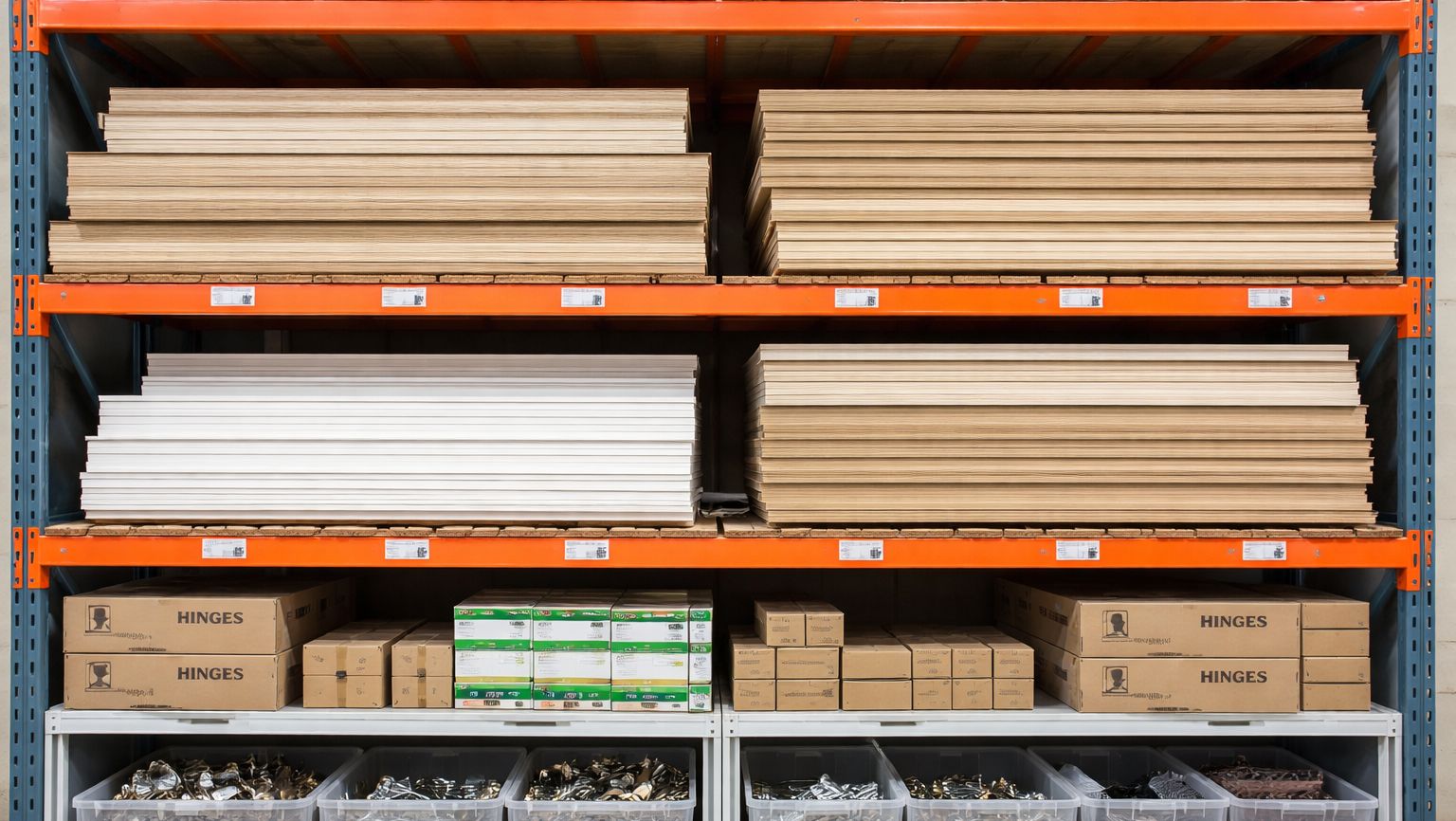
For each cabinet, you need to account for every material component. This includes:
- Sheets of board - Particle board, plywood, MDF, or other substrates
- Hardware - Hinges, drawer runners, handles, locks, catches or feet
- Edge banding - Edge tape for visible edges
- Adhesives - Glues, contact adhesive and sealants
- Finishing materials - Paint, stain, lacquer, or other finishes
- Laminate materials - Timber veneer laminate or decorative laminates if used
- Workshop consumables - Screws, nails, dowels, biscuits, shelf pins and any other small items
- Material waste - An allowance for material waste from cutting and mistakes
The key is to be thorough. Many businesses price the major materials correctly but forget to account for the small items like screws, glues or edge banding. Although small, over many jobs, these forgotten costs add up significantly.
Accounting for material waste
No cabinet maker uses 100% of every sheet of material (if you do, you’re either onto something, or spending too much time micro-optimising). You need to factor in waste from cutting, mistakes, and offcuts that are too small to use on future jobs.
A good rule of thumb is to add a 10-15% waste factor to your sheet materials. For hardwood or expensive veneers, you might be a little more careful when working with it and use a 15-20% waste factor. For consumables like screws and adhesives, a smaller 5% buffer can work well.
Tracking material prices accurately
Material prices fluctuate continuously, sometimes quite dramatically as supply chain issues pop up. Make sure you’re basing your estimates on current supplier prices, not what you paid six months ago. Also, if you are working on a large job, check if your suppliers will offer project-based discounts that can reduce costs.
The best approach is to maintain a materials library in your estimating system with up-to-date pricing. Update these prices regularly, ideally monthly, or whenever your suppliers change their pricing. This ensures every estimate starts from accurate baseline costs.
Calculating labour costs
Labour is another area where cabinet makers commonly underestimate and lose money. It’s not just about how long it takes to knock up the cabinets - you need to factor in every hour that goes into the job across the whole process.
Breaking down labour by task
Different tasks require different skill levels and take different amounts of time. You should break your labour down into specific categories:
- Design/drafting - Time spent designing the cabinets and producing shop drawings
- CNC machining - Time on the CNC machine for cutting panels and drilling holes
- Cutting and machining - Time on the saw, edge bander, and other machines
- Assembly - Putting the cabinets together
- Finishing - Sanding, painting, or staining time - if you do any natural timber work
- Installation - On-site fitting time, including travel - may not be an hourly rate if using a cabinet rate
- Project management - Time coordinating the job, ordering materials, and client communication
Each of these tasks should have an estimated time and an hourly rate, which will vary by the type of cabinet too. Your machine operators will likely have a different hourly rate than your assemblers, who have a different rate than your installers.
Finding accurate hourly rates
Your labour rate needs to cover more than just wages. For every employee working on a project, you need to factor in:
- Base wage - The actual hourly pay rate - or salary equivalent
- Superannuation - Employer contributions (typically 12% in Australia as of writing)
- Workers compensation insurance - Usually calculated as a percentage of wages
- Payroll tax - If applicable in your state and company size
- Leave provisions - Annual leave, sick leave, and public holidays - this should be factored into the hourly rate to cover the downtime when employees are on leave
- Training costs - Ongoing skills development
- Recruitment costs - Time and resources spent hiring and onboarding new employees
- Employee benefits - Any additional benefits you provide (bonuses, company car, etc)
As a rough guide, the true cost of an employee is typically 1.3 to 1.5 times their base wage when you factor in all these additional costs. So if you’re paying someone $30 per hour, the true cost to your business might be $39-$45 per hour.
Building a labour library
Just like with materials, the most efficient way to estimate labour is to build a library of the different rates. For example (using made up numbers):
- CNC machine operator - $45/hour
- Cabinet assembler - $40/hour
- Installer - $50/hour
- Project manager - $60/hour
- Designer/drafter - $55/hour
Then when you’ve worked out how long each tasks takes on average, you can work out the labour cost for each task. For example (again, using made up numbers):
- Standard kitchen base cabinet assembly - 0.5 hours * $40/hour = $20
- Standard kitchen wall cabinet assembly - 0.4 hours * $40/hour = $16
- Drawer construction per drawer - 0.2 hours * $40/hour = $8
- CNC cutting per sheet - 0.5 hours * $45/hour = $22.50
- Installation per cabinet - 0.3 hours * $50/hour = $15
Now you know exactly how expensive each task is and can price it accordingly.

Factoring in overheads
Your overheads are all the costs of running your business that aren’t directly tied to a specific job. If you don’t factor these into your pricing, you may as well be working for free.
What are overhead costs
Overhead costs include everything required to keep your business running:
- Rent or mortgage - Your workshop and office space
- Utilities - Electricity, water, gas, internet, phones
- Insurance - Public liability, professional indemnity, building insurance
- Equipment maintenance - Servicing and repairs for machinery
- Equipment depreciation - The cost of replacing machinery over time
- Software subscriptions - Estimating & business software, accounting software, design software
- Office supplies - Stationery, consumables for the office
- Marketing and advertising - Website, social media, traditional advertising
- Professional fees - Accountant, bookkeeper, legal advice
- Vehicle costs - Fuel, maintenance, registration, insurance for company vehicles
- Bank fees and interest - Business loan interest, merchant fees
- Salaries for non-production staff - Admin, sales etc
Calculating your overhead recovery rate
To factor overheads into your pricing, you need to calculate an overhead recovery rate. Here’s how:
- Calculate total annual overheads - Add up all your overhead costs for the year
- Calculate total annual direct labour hours - Estimate how many productive hours your team will work on actual jobs (not total hours, just productive job hours)
- Divide overheads by labour hours - This gives you an overhead rate per labour hour
For example, if your annual overheads are $150,000 and you have 3,000 direct labour hours per year, your overhead rate is $50 per labour hour.
This means for every hour of labour you estimate on a job, you need to add $50 to cover your overheads. So if a job requires 20 hours of labour at a cost of $40 per hour ($800), you need to add $1,000 for overheads, bringing your total labour and overhead cost to $1,800.
Some businesses prefer to calculate overheads as a percentage of direct costs instead. If your total direct costs (materials + labour) are typically $100,000 per year and your overheads are $50,000, your overhead rate would be 50% of direct costs.
Adding your profit margin
After accounting for materials, labour, and overheads, you need to add your profit margin. This is not the same as covering your costs - profit is what’s left over after all expenses are paid.
Determining appropriate profit margins
Profit margins in the cabinet making industry typically range from 10% to 30% depending on several factors:
- Complexity of the work - Custom, intricate work can command higher margins
- Market conditions - Competitive markets may have lower margins
- Quality and reputation - Established businesses with strong reputations can charge more
- Project size - Larger projects may have lower percentage margins but higher dollar profits
A 20% profit margin is a good target for most cabinet making businesses. This means if your total costs (materials + labour + overheads) are $10,000, your quote should be $12,000 (plus GST/VAT of course).
Adjusting for risk and complexity
Not every job should have the same margin. Consider adjusting your profit margin based on:
- Project complexity - More complex or first-time projects carry more risk
- Client reliability - New clients or those with payment history issues
- Timeline pressure - Rush jobs that require overtime or rescheduling
- Design changes - Projects likely to have variations and changes
- Site conditions - Difficult access or installation conditions
Adding 5-10% contingency to high-risk projects can save you from losing money if things don’t go to plan.
Putting it all together with estimating software
Now that we’ve covered the ground work, let’s talk about how to put this into practice effectively. Trying to calculate all of these costs manually for every job is time-consuming and prone to errors. You can try and use spreadsheets, but they quickly become unwieldy and difficult to maintain as your business grows and the level of detail increases.
This is where a good estimating system becomes invaluable. Estimating software like Acrual is specifically designed around this labour and materials based approach to estimating.
How Acrual helps with cabinetry pricing
Acrual allows you to build comprehensive libraries of materials and labour types with their associated costs. You can then create a library of common modules for your cabinets with all the materials and labour required for each.
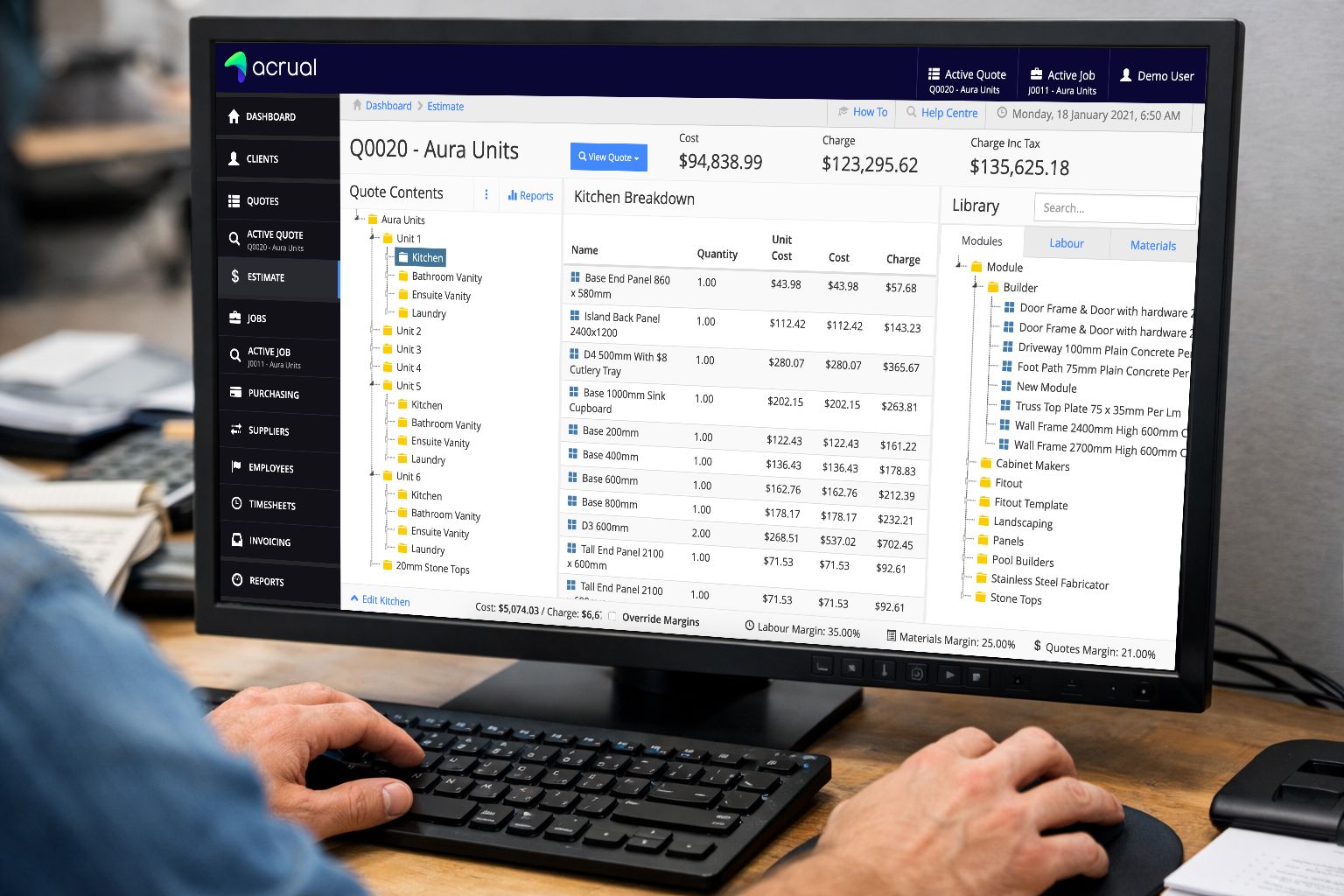
When you’re estimating a new project, you simply drag in the modules you need from your library. Acrual automatically calculates:
- Total material costs based on your current pricing
- Total labour costs based on task timings and rates
- Markup for overheads based on your calculated overhead recovery rate
- Suggested quote price + taxes
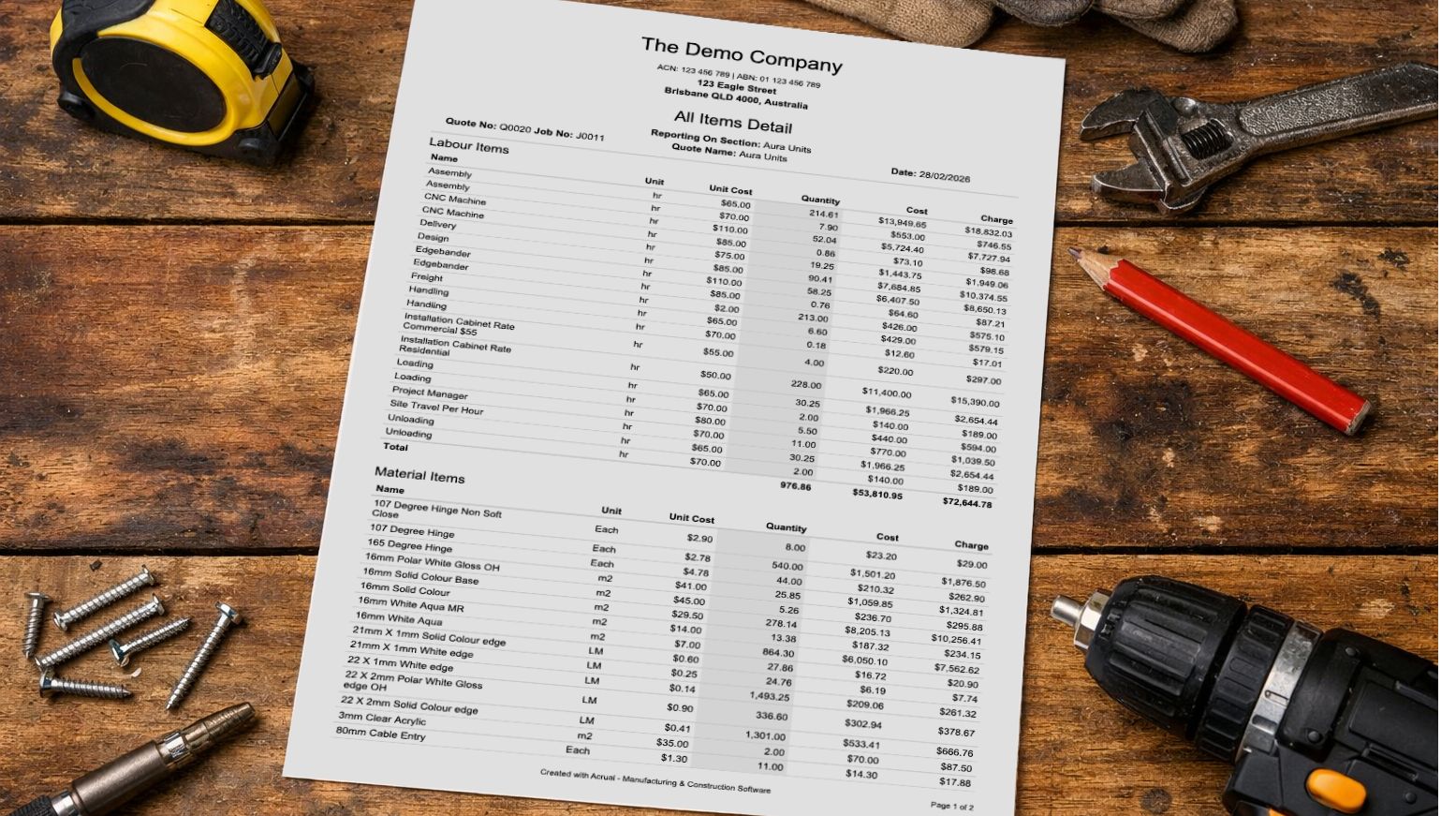
You can also generate detailed material and labour reports that break down exactly what you need to order and how many hours each labour centre needs to allocate. This level of detail makes it significantly easier to plan and manage projects profitably.
Benefits of a structured approach
Using structured estimating software means:
- Consistency - Every estimate uses the same methodology and current pricing
- Speed - Estimates that used to take hours can be done in minutes
- Accuracy - Less chance of forgetting items or making calculation errors
- Learning - Compare estimated vs actual costs to improve future estimates
- Reporting - Understand which types of projects are most profitable
The time saved on estimating can be spent on other valuable activities like following up quotes, improving your processes, or taking on more work.
Other important pricing considerations
Beyond the core costs, there are a few other factors to consider when pricing cabinetry.
Warranties and callbacks
Factor in the cost of warranty work and potential callbacks. Even with perfect workmanship, you may need to adjust a door or drawer after installation. Including a small allowance (1-2% of the project value) for warranty service helps cover these inevitable costs.
Competitive intelligence
While you should never just match competitor pricing without understanding your costs, it’s useful to know where the market stands. It can be worth requesting quotes from competitors periodically to understand where your pricing sits in the market.
If you’re consistently more expensive, re-check your costs and profit margins, and make sure you can articulate your value proposition. If you’re consistently cheaper, you might be leaving money on the table with your profit margins or not covering all your costs.
Common pricing mistakes to avoid
Let’s wrap up by covering some common mistakes that can hurt your profitability:
Underestimating installation time
Installation almost always takes longer than expected, especially on older buildings or challenging sites. Always add buffer time for unexpected issues like uneven floors, walls that aren’t square, or hidden obstacles. Make sure you keep track of this over time too, so you can adjust accordingly.
Forgetting about shop supplies
Sandpaper, rags, masking tape, cleaning products, and other consumables add up. Make sure these are included in your overhead calculations.
Not updating pricing regularly
Your costs change over time. Review and update your material prices and labour rates at least quarterly, preferably monthly.
Pricing based on what you think the customer will pay
Always start from your costs and add your margin. If the resulting price is too high for the market, look at ways to reduce your costs or improve efficiency, don’t just drop your margin hoping to win the work.
Not tracking actual costs vs estimates
The only way to improve your estimating accuracy is to track actual costs against your estimates. Review completed jobs to see where you over or under estimated, and adjust accordingly.
Conclusion
Pricing cabinetry accurately requires a systematic approach that accounts for every cost in your business. By breaking down projects into materials, labour, and overheads, then adding an appropriate profit margin, you can price with confidence knowing you’re covering your costs and making profit.
The key is to be thorough, track everything, and continuously refine your approach based on real job data. Using structured estimating software like Acrual makes this whole process faster, more accurate, and more profitable.
We hope this post has helped you understand how to price your cabinetry more effectively. If you have any questions or would like to discuss your specific pricing challenges, don’t hesitate to get in contact.
If you feel like taking a step in the right direction with your estimating, give Acrual estimating software a go. It’s designed specifically for cabinet makers and joinery businesses to estimate accurately and maximise profit. Check it out here.